


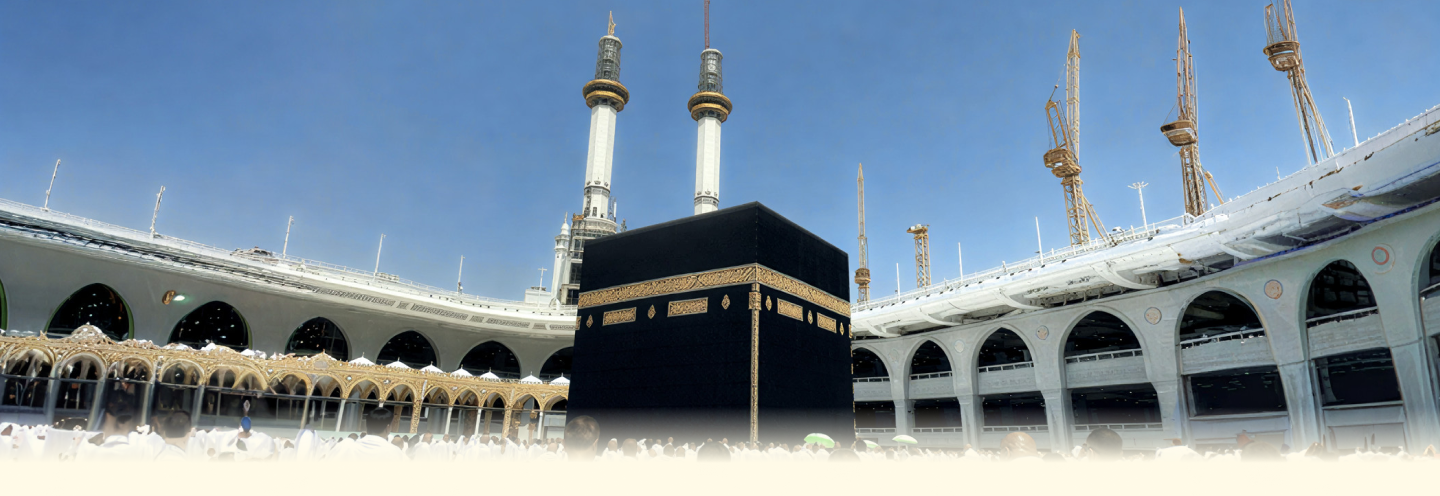
Tawaaf
The Sacred Circumambulation of the Kaaba

Description
Tawaaf is one of the most significant rituals in Islam, performed by millions of Muslims during Hajj and Umrah. It involves walking seven times around the Kaaba in a counter-clockwise direction, beginning and ending at the Black Stone (Hajr-e-Aswad). More than just a physical movement, Tawaaf symbolizes unity, devotion, equality, and submission to Allah (SWT).
When pilgrims enter the Masjid al-Haram in Makkah, the sight of the Kaaba is overwhelming. Their hearts overflow with gratitude and humility as they join countless believers in performing Tawaaf. This timeless ritual links the present-day Muslim Ummah with the legacy of Prophet Ibrahim (A.S.), who built the Kaaba, and Prophet Muhammad (S.A.W.), who revived its true purpose.

Historical Background of Tawaaf
The Kaaba was built by Prophet Ibrahim (A.S.) and his son Ismail (A.S.) as a house dedicated solely to the worship of Allah.
Since then, Muslims from every part of the world have continued this practice as an act of worship.
Even before Islam, Arabs used to perform Tawaaf, but with misguided beliefs. Prophet Muhammad (S.A.W.) restored it to its pure monotheistic form.
Today, Tawaaf remains at the heart of Hajj and Umrah rituals, reminding Muslims of their covenant with Allah.

Meaning and Symbolism of Tawaaf
Tawaaf means "to encircle" or "to walk around."
It signifies that Allah is the center of a Muslim's life, and everything should revolve around His command.
The circular movement resembles the orbit of planets and stars, showing the harmony of creation in glorifying Allah.
It symbolizes equality, as Muslims—rich and poor, powerful and weak—stand shoulder to shoulder in identical ihram clothing.

Types of Tawaaf
Performed by pilgrims upon reaching Makkah for Hajj.
A compulsory part of performing Umrah.
A pillar of Hajj, performed after standing at Arafat.
The final act before leaving Makkah.
Pilgrims may perform extra Tawaaf whenever they wish as an act of devotion.

How to Perform Tawaaf (Step by Step)
Make the Intention (Niyyah): A sincere intention to perform Tawaaf solely for Allah’s sake.
Begin at the Black Stone: Raise your hands, say “Bismillah, Allahu Akbar”, and start the first round.
Walk Counter-Clockwise: Keep the Kaaba on your left and walk in humility.
Complete Seven Circuits: Each round starts and ends at the Black Stone.
Recite Dua & Dhikr: There are no fixed supplications—pilgrims may recite Quran, dhikr, or personal duas
Maqam Ibrahim: After finishing, perform two rakats of Salah behind Maqam Ibrahim if possible.
Drink Zamzam Water: Many pilgrims refresh themselves with Zamzam after Tawaaf.

Etiquettes of Tawaaf
Purity
A pilgrim must be in a state of wudhu (ablution).Clothing
Men wear ihram with right shoulder exposed (Idtiba), while women dress modestly.Calmness
Avoid rushing, pushing, or harming others.Focus
Keep the heart connected to Allah and avoid distractions.Respect
Do not raise your voice unnecessarily; maintain dignity and humility.
Spiritual Benefits of Tawaaf
Millions gather, regardless of language or nationality, as one Ummah.
All are equal before Allah, with no distinction of wealth or status.
Just as the Kaaba is the center, Allah should remain the center of our lives.
Each round helps purify the heart and strengthens the bond with Allah.
Prophet Muhammad (S.A.W.) said one who performs Tawaaf sincerely receives rewards and forgiveness.
Explore Umrah Packages by Month
Explore Umrah Packages by Days
Explore Umrah Packages by Departure Airport
Explore Umrah Packages by Nearby Location



© 2026 Bashaarat. All rights reserved.
Enquire Now
Share your enquiry and we’ll connect with you to
assist with your Hajj or Umrah plans.